October 09, 2026 | Facelift
9 minute read

One of the most common questions I hear from patients considering a facelift is: “What will I actually look like during recovery?” Traditional before-and-after photographs are helpful for understanding what facial rejuvenation can accomplish, but they usually skip an important part of the process: what happens in between.
With her permission, one of my patients generously documented her recovery during the first two weeks after surgery. Her photographs provide a real-world look at how swelling, bruising, incisions, and facial appearance can change remarkably quickly during the early stages of healing.
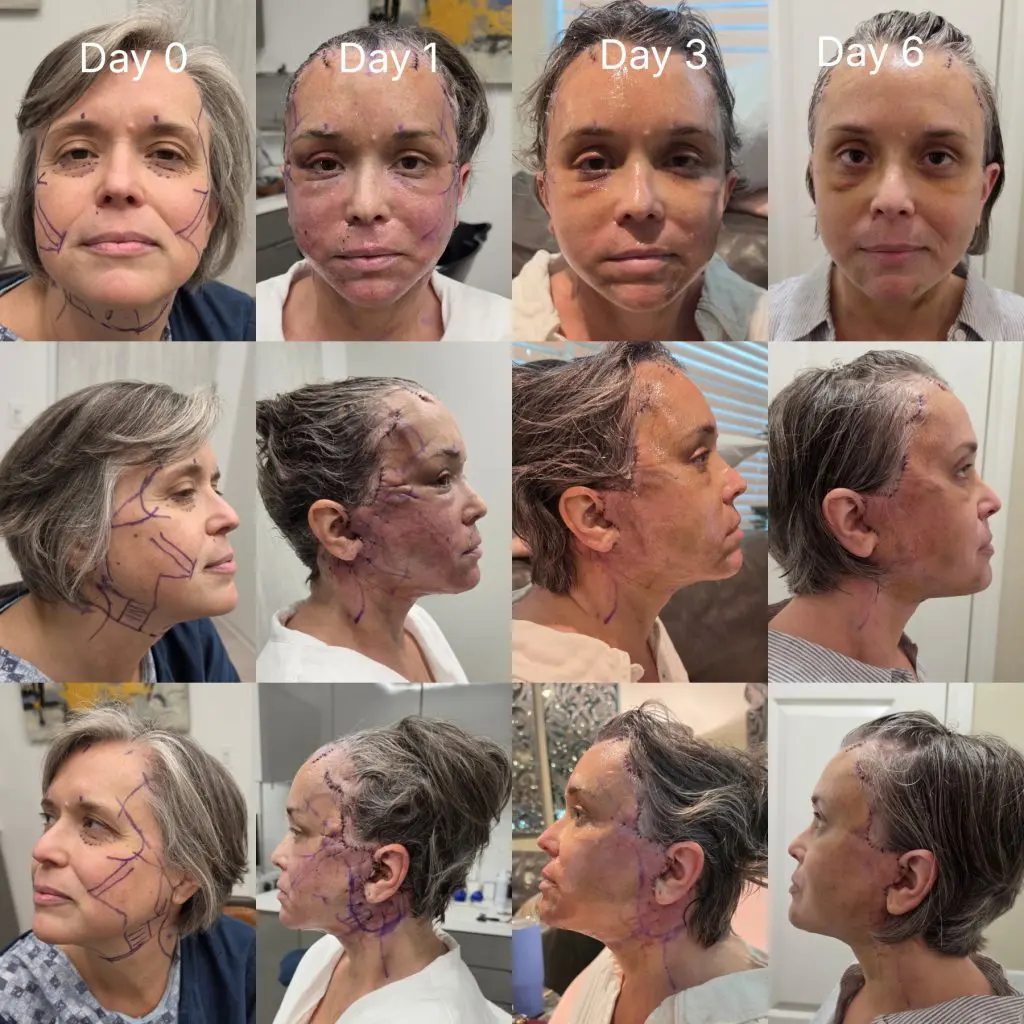
This series follows one patient’s individual recovery. The amount of swelling and bruising—and the pace at which they resolve—can vary considerably from patient to patient.
Table of Contents
- Her Story: Facial Rejuvenation After Significant Weight Loss
- Day 0: Before Surgery
- Day 1: The Early Postoperative Appearance
- Day 3: Swelling and Bruising Are Still Part of the Process
- Day 6: A Significant Change in Less Than a Week
- Two Weeks After Facial Plastic Surgery: Looking More Like Herself
- When Will I Look Normal After Facelift Surgery?
- What About an Important Event?
- Why I Wanted to Share This Recovery
- Why Choose Dr. Sean Delaney for Your Facelift?
Her Story: Facial Rejuvenation After Significant Weight Loss
This patient is in her late 40s and has undergone significant weight loss.
Losing a substantial amount of weight can be a tremendous accomplishment, but it can also produce changes in the face. As facial volume decreases, skin laxity and changes in the jawline and neck may become more apparent. Some patients tell me that after losing weight and feeling healthier, the reflection they see in the mirror doesn’t quite match how they feel.
After her weight-loss journey, this patient decided that facial rejuvenation would be something she did for herself.
We developed a comprehensive treatment plan that included:
- Endoscopic brow lift
- Transconjunctival lower blepharoplasty
- Deep plane face and neck lift
- Buccal fat reduction
- Full-face fractional CO₂ laser resurfacing
Each procedure addressed a different component of facial aging. The deep plane face and neck lift addressed laxity of the mid and lower face, jawline, and neck. The brow lift and lower eyelid surgery addressed the upper face and lower eyelids, while fractional CO₂ resurfacing was used to improve skin quality.
Because she underwent multiple procedures simultaneously, her photographs should not be interpreted as the expected recovery from an isolated facelift. They represent one patient’s experience after comprehensive facial rejuvenation.
Day 0: Before Surgery
Her preoperative photographs show where we started.
When planning facial rejuvenation, my goal is not to create a different face or make someone look artificially tight. I want to address the structural changes associated with aging and, in this case, significant weight loss while preserving the patient’s natural features.
For this patient, that meant looking at the face as a whole rather than treating one isolated area.
Day 1: The Early Postoperative Appearance
The first day after facial rejuvenation surgery can look dramatic.
Swelling, bruising, tightness, and visible incisions are all expected during this stage. When multiple procedures are performed together, swelling can involve the forehead, eyelids, cheeks, jawline, and neck.
This is one reason I think photographs of the actual recovery process are so valuable. Patients describe beautiful three- or six-month facelift results online but rarely see what happened during the days required to get there.
Day one is not a result. It is simply the first day of healing.
Even at this early stage, changes in the jawline and neck may be visible, but swelling makes it far too early to evaluate the ultimate result. Keeping your head elevated during this period can help minimize swelling and support your healing skin.
Day 3: Swelling and Bruising Are Still Part of the Process
By day three, swelling and bruising remain quite noticeable.
This can sometimes be frustrating for patients because a smooth recovery doesn’t necessarily happen in a perfectly straight line. Bruising can migrate, swelling can fluctuate, and one side may temporarily look different from the other.
Those changes are part of normal early healing.
In this patient’s photographs, however, you can already see her beginning to look more like herself as the immediate postoperative changes start to settle.
Day 6: A Significant Change in Less Than a Week
By day six, the progression becomes much easier to appreciate.
There is still bruising and swelling. Her incisions remain visible. The tissues are still early in the healing process. But compare day 6 with day one, and the difference is substantial.
This illustrates an important distinction I discuss with patients: looking much better is not the same thing as being completely healed.
Patients can become increasingly comfortable with their appearance while considerable healing is still occurring beneath the surface.
Swelling continues to resolve over the following weeks and months. Incisions gradually fade, tissues soften, and the facial and neck contours continue to settle.
Two Weeks After Facial Plastic Surgery: Looking More Like Herself


By two weeks, the change from the first few postoperative days is striking.
She still has some residual swelling and bruising, and her incisions are clearly still healing. This is absolutely not her final result.
However, she already looks much more like herself.
From the frontal view, the face remains natural and recognizable. The early postoperative swelling has decreased considerably, while the brow, eyelid, facial, and neck changes are beginning to come together.
The profile is particularly helpful for understanding the early change in the lower face and neck.
In just two weeks, the improvement in the jawline and neck contour is already becoming apparent. There is still swelling present, and the tissues will continue to soften and settle over the coming months.
This is why I generally think of the two-week point as an important milestone rather than an endpoint.
Patients are moving beyond the most obvious portion of early recovery, but their result is still evolving.
When Will I Look Normal After Facelift Surgery?
There isn’t a single day when every facelift patient suddenly looks completely healed.
During the first week, swelling, bruising, and visible incisions are expected. By the second week, many patients are looking considerably more like themselves and may feel increasingly comfortable being seen socially.
That does not mean healing is complete in two weeks.
Residual swelling can persist for weeks and sometimes months. Incision scars mature over time. Areas of firmness, tightness, numbness, or temporary asymmetry can occur during the healing process. The face and neck gradually soften as the tissues settle into their new position.
The timeline also depends heavily on what procedures are performed.
Someone undergoing an isolated face and neck lift may recover differently from a patient like this one who combined a deep plane face and neck lift with brow surgery, lower eyelid surgery, buccal fat reduction, and full-face fractional CO₂ resurfacing.
What About an Important Event?
Another common question patients ask is, “When will I feel comfortable being seen after my facelift?”
I generally recommend thinking about recovery in three milestones:
- Two weeks: Most patients are comfortable getting out of the house for everyday activities such as grocery shopping or a casual dinner. Some swelling or bruising may still be visible, and moderate discomfort around your incision sites may be normal.
- Four weeks: This is a reasonable guideline for social downtime. Most patients begin to feel much more comfortable being around friends, attending social activities, and returning to their usual routine, although the result is still healing.
- Three months: For a major event—such as a wedding, reunion, important vacation, or an event where you know you’ll be photographed—I recommend allowing approximately three months whenever possible.
Treat these as guidelines rather than guarantees. Every patient heals at a different pace, and the timeline can vary depending on the facial rejuvenation procedures performed.
When planning surgery around an important date, I would much rather give you extra time than have you worrying about residual swelling or bruising as the event approaches. Our office can help you work backward from your event date to choose an appropriate time for surgery.
Why I Wanted to Share This Recovery
I think there is tremendous value in showing patients more than polished before-and-after photographs.
Facial rejuvenation is a gradual process. There is the decision to have surgery, preparation beforehand, the operation itself, the first few challenging days, the transition back toward a completely normal life, and then several months during which the result continues to mature.
Showing that process helps patients enter surgery with realistic expectations. Every patient heals differently. The photographs shown here represent one patient’s individual experience and are not a guarantee of a particular recovery timeline or surgical result. Photographs are shared with patient permission.
These photographs also demonstrate something else I consider equally important: despite undergoing comprehensive facial rejuvenation, she still looks like herself.
The goal was never to change who she was. It was to address the effects of aging and significant weight loss while preserving the features that make her recognizable as herself. For this patient, surgery was also a personal reward after an important accomplishment in her life.
I am especially grateful to her for allowing us to share such a personal part of her experience. By documenting the days that most before-and-after galleries leave out, she is helping other patients better understand what facial rejuvenation recovery can actually look like.
Thank you to our lovely patient for allowing us to share her journey.
Why Choose Dr. Sean Delaney for Your Facelift?
Sean Delaney, M.D., is double board certified in plastic and reconstructive surgery. He has extensive training and hands-on experience with a range of facial surgeries, including deep plane facelifts, rhinoplasty, eyelid surgery, neck surgery, and more.
Dr. Delaney incorporates modern facial rejuvenation techniques into each patient’s surgical plan, approaching every treatment with compassion and individualized attention. Rather than simply tightening the face, his goal is to create natural-looking results that align with the patient’s existing facial features and preserve what makes them look like themselves. Whether it’s prescribed pain medication or specific post-op guidance, Dr. Delaney ensures that you feel supported and informed.
Patients considering facelift surgery in Houston, TX, and beyond can meet with Dr. Delaney to discuss their concerns, aesthetic goals, and the surgical approach that may be best suited for their desired outcomes.
Learn More About Your Facelift Recovery Timeline in Houston, TX
While facelift recovery needs vary from patient to patient, you do not have to navigate the process alone. During your visit, board-certified plastic surgeon Dr. Sean Delaney will take the time to understand your facial anatomy and guide you through your facelift procedure from consultation to recovery.
Start your facial rejuvenation journey today by calling (713) 562-5665 or completing our online contact form.